

Picture two Indian SMEs with 40 people each at the start of 2026. By June, the one with more AI talent had grown its team about 5.2 percentage points faster than the other, which on our arithmetic is about two more people.[1] That is an average across many firms, not a promise for yours.
AI skills and AI layoffs are in the news together this week. SAP is reported to be weighing at least 10,000 job cuts as it rebuilds its software business for AI,[2] and it is fair to ask whether a small company should follow.
This post is for SME owners and operations heads. It covers what India's own data on small and medium businesses (SMBs) shows, where to start building AI skills, which guardrails to set first and how to treat anyone whose role changes, with our checklist for a 20 to 50 person team. The short answer: for most SMEs, the better AI move is to build everyday AI skills across the team, one workflow at a time, not to cut jobs.
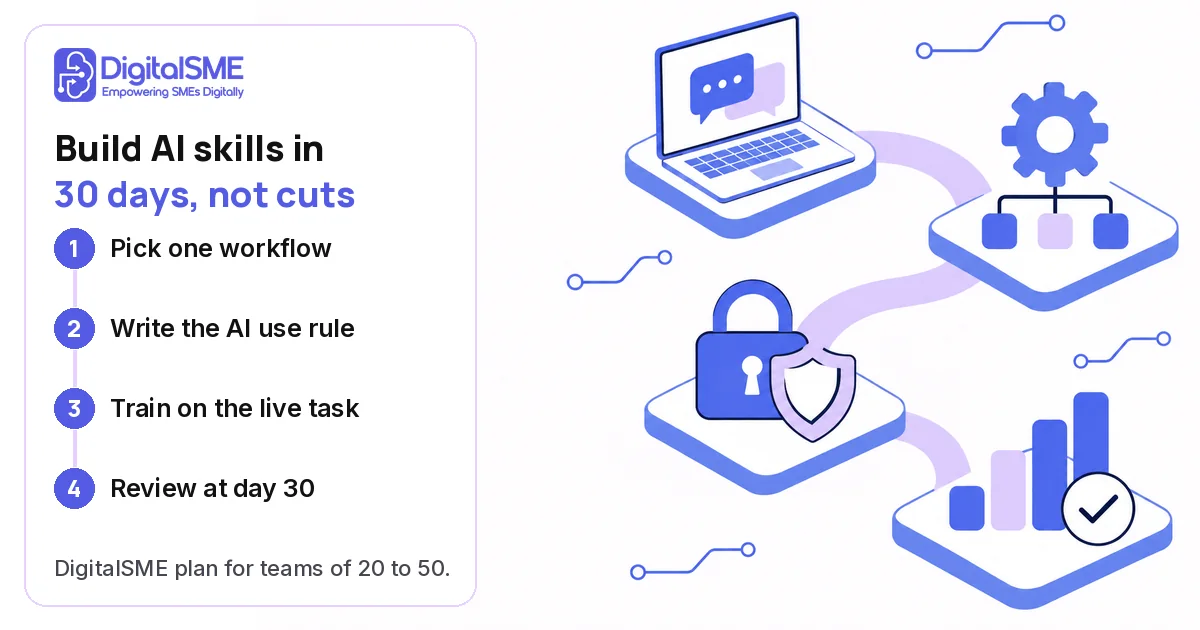
Table of Contents
- AI layoffs at big firms are not a plan for a 40-person company
- Indian SMEs with AI talent grew their teams faster, not smaller
- AI literacy is the real gap, not a shortage of AI engineers
- Start with one workflow, such as sales follow-up or routine HR questions
- Set guardrails before anyone connects AI to company data
- AI training for employees works best when it is tied to real work
- If a role changes, redeploy and retrain first
- How we would build AI skills in a 20 to 50 person team
- What to watch in December, and what to do this week
- Frequently asked questions
- References
AI layoffs at big firms are not a plan for a 40-person company
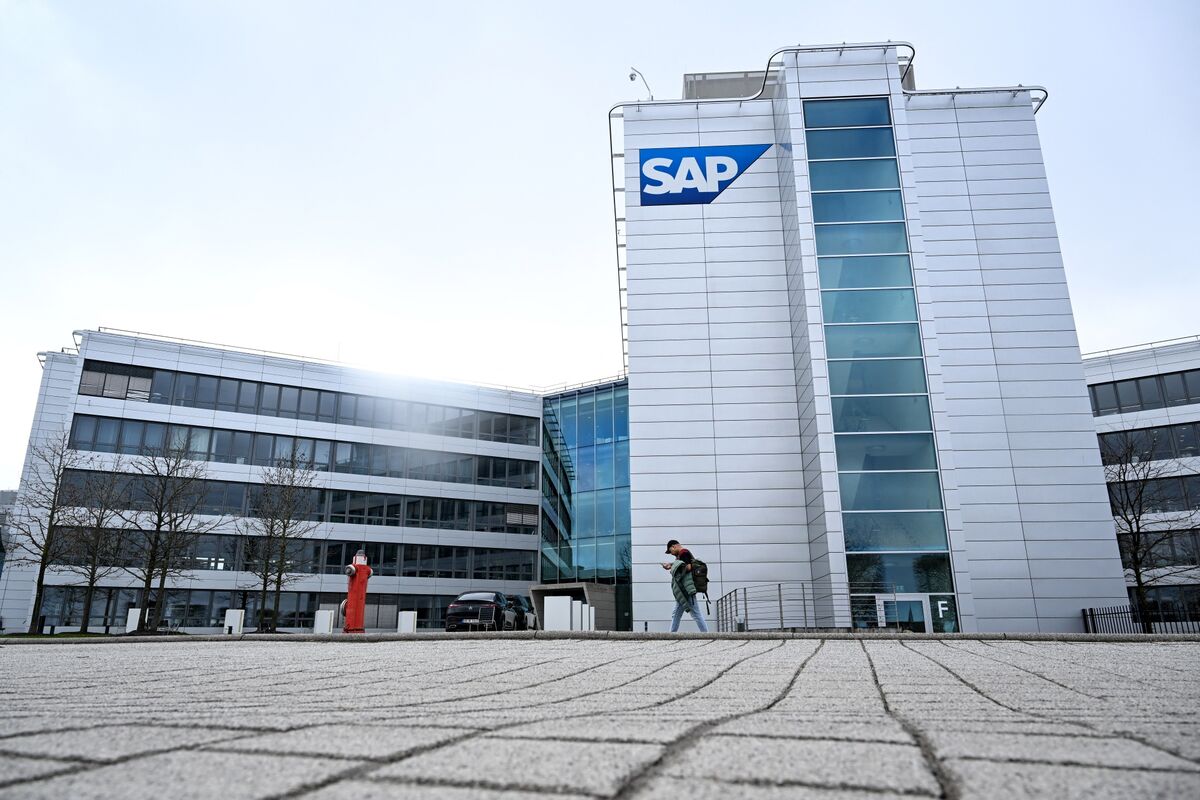
Image: Bloomberg. Click to read the full report.
A restructuring at a global software company is a poor guide to how a 40-person firm should staff its team. SAP's plan covers a company of more than 110,000 people, and it is not final.[3] The cuts would affect at least 9% of the global workforce, and the number might still change after labor negotiations.[2] All departments were asked to name possible cuts, with product, engineering and sales in particular focus.[3]
The company's own words are milder. SAP has said that roles and functions "will naturally change over time" and that no decisions have been made on any further measures.[3] It has also been through this before. A 2024 reorganization removed around 10,000 positions through a program that relied mainly on voluntary departures and retraining, and headcount later stayed relatively flat as the company hired for new roles.[3] Even at that size, the last round leaned on voluntary exits and retraining first, the order we would follow in an SME too.
The US numbers add caution. Through October, AI was cited in about 20% of announced job cuts by US employers. It was cited for only 1,265 cuts in October, the lowest month of 2026, and economic conditions have now overtaken it as the leading reason.[4] Those are US figures, not Indian ones.
Do not copy a restructuring built for 110,000 people. Ask a smaller question instead: where would your people save time if they knew how to use AI well?
Indian SMEs with AI talent grew their teams faster, not smaller
Indian SMEs with more AI talent added staff faster than their peers in the first half of 2026. Their headcount rose 5.2 percentage points faster than that of peers with lower AI adoption, more than double the global SMB gap of 2.1 points (here, percentage points measure the gap between the two groups' growth rates, not 5.2% more staff).[1] In the LinkedIn and Zoho report, an SMB counts as AI-enabled when at least 5% of its employees are AI talent: people in AI-related roles, or people who list at least two AI engineering skills on their profiles.[1]
The lift was not limited to technology firms. The table shows the headcount growth lift by sector for AI-enabled SMBs over their peers.
| Sector | Headcount growth lift, H1 2026 |
|---|---|
| Technology | +8.9 percentage points |
| Construction | +7.7 percentage points |
| Wholesale | +7.3 percentage points |
| Financial Services | +6.9 percentage points |
| All Indian SMBs in the study | +5.2 percentage points |
Source: the report above, first half of 2026.[1]
On our arithmetic, 5.2 percentage points on a 40-person team is 40 multiplied by 0.052, or about two people over six months.[1] Read that with care: the findings are observed associations, not proof of cause,[1] so growing firms may simply be the ones that hire AI talent. The gap is also much smaller at mid-market companies, at 0.9 points, which suggests the link is strongest among smaller businesses.[1]
When you plan next year's hiring, plan AI skills alongside headcount.
AI literacy is the real gap, not a shortage of AI engineers
A typical SME uses AI tools built by others, so the skill it needs is everyday use. In the same data, 16.3% of SMBs have AI engineering skills in-house, but only 6.1% have employees with everyday AI literacy, such as using generative AI tools in daily work.[1] On our arithmetic, engineering skills are about 2.7 times as common as everyday skills.[1]
These figures count skills listed on professional profiles, not actual AI use,[1] so the true picture may differ. They still show where the gap sits. A retailer or a manufacturer does not need to build AI, but its people need to know how to use it.[1] LinkedIn's India country manager, Kumaresh Pattabiraman, described the goal as making AI "a skill for every employee, not a specialist skill for a few."[5]
Before you search for an AI specialist, check whether your current team can use the AI tools you already pay for.
Start with one workflow, such as sales follow-up or routine HR questions
One good first workflow is drafting sales follow-up emails or answering routine HR queries.[1] Pick a job that repeats every week and whose result a person can check quickly; both of these sit close to revenue or time.
Sales has the clearest numbers. Over a trailing 12-month window, sellers using AI carried out roughly 40% more prospecting and outreach per seller, and connected with nearly twice as many decision-makers as sellers who did not.[1] Use of CRM workflow automation also rose 41.9% between June 2025 and May 2026.[1] As an illustration on our arithmetic, two salespeople doing 50 outreach actions a week each make 100 in total, and 40% more is about 40 extra actions a week.[1]
HR use grows with company size. Among Zoho People customers, 8.6% of micro-firms with 1 to 10 users use AI in their HR tools, against 29.6% of larger SMBs with 51 to 200 users. This may be because routine questions pile up as headcount grows, and the figures cover one HR feature, not AI use across the business.[1] If your team is under 10 people, we would start with sales follow-up and add HR questions as headcount grows.
Pick one of these two workflows, write down how long it takes today, and start there.
Set guardrails before anyone connects AI to company data
Set rules for tools and data before any AI tool touches company systems, because an AI tool can reach whatever you let it connect to. Connect AI to the tools you already use, within your existing permissions and data policies.[1]
A "graduated trust" approach fits here: start with low-risk uses and widen AI's role as confidence grows. One example is connecting a familiar AI assistant to your CRM so you can ask about your pipeline in plain language, once access controls, data-protection obligations and vendor terms have been reviewed.[1] In a 20-person team, we would keep that first connection to questions only until the 30-day review.
Two of our earlier guides cover the checks that matter most. Our guide to AI agent security for Indian SMEs covers what a connected tool can reach, and our post on four questions to ask any AI provider covers what a vendor keeps and trains on by default. Read both before the first real prompt.
Write a one-page AI use rule before the first workflow goes live. It should say which tools are allowed, which data never goes in, and who can connect a tool to company data. This rule is our suggestion.
AI training for employees works best when it is tied to real work
AI training for employees is most likely to change the work when people practice on a live task. Short online courses and peer learning are a fair start, followed by encouraging staff to find ways to use AI in their everyday work.[1] A course on its own may not be enough.
The IT employees' forum NITES sets a higher bar: reskilling that is "meaningful and outcome-oriented", with access to online courses alone not counting as adequate support.[6] That demand is aimed at IT companies laying people off,[6] but the test fits an SME too: did the training change how the work gets done?
Put the two together and you get a simple design: a short course, one live workflow to practice on, and a weekly review of what worked. A course gives your team the vocabulary, and the live workflow shows whether it works. This design is our suggestion.
Measure the hours saved and where they went. If the hours move into customer calls, quotes and follow-ups, the training is likely paying off. If they simply vanish, the workflow needs a fix. Set a 30-minute weekly slot where one person shows a prompt or shortcut that worked. For example, a small sales team could use its first slot to compare the follow-up emails that got replies with the ones that did not.
If a role changes, redeploy and retrain first
Some roles will change, and good owners plan for that early. The forum's president, Harpreet Singh Saluja, framed its proposals as a trade: companies should be free to adopt new technology, but they "must also take responsibility" for the employees whose livelihoods are affected.[6]
The proposals start with a policy framework to protect IT and ITeS (IT-enabled services) employees from AI-driven displacement, with mandatory disclosure of AI-related job losses, and cover reasonable advance notice, fair severance, all outstanding statutory and contractual dues, and upskilling and redeployment before positions are eliminated.[6] Change is expected even at SAP,[3] so the useful question is what you do first.
In a 40-person company, the same order works as a plan. Redeploy and retrain first, and talk to people early. Notice, severance and dues follow legal rules that depend on your contracts and your location, so take advice from a labor lawyer before you act. This is general information, not legal advice.
For each role AI could change, write down the tasks that could move to AI and the new work that person could take on instead.
How we would build AI skills in a 20 to 50 person team
If we were setting this up for your team, we would follow these seven steps in this order. This is our own approach, built on the report's three steps.[1]
- Step 1. Pick one workflow. Choose sales follow-up emails or routine HR questions, and time the task as it runs today.
- Step 2. Write the AI use rule. List the allowed tools, the data that never goes in and who approves a new connection, and connect tools only inside existing permissions.
- Step 3. Name one AI champion per team. Choose a practical peer who likes to try tools, not a new specialist hire.
- Step 4. Train on the live workflow. Combine a short online course with a weekly 30-minute practice session on the real task.
- Step 5. Track hours saved. Note where the time went: more customer calls, faster quotes or fewer errors.
- Step 6. Review after 30 days. Keep, change or stop the workflow, then add the next one. Our comparison of ChatGPT, Gemini and Claude for Indian SMEs can help you choose the tool.
- Step 7. Fix HR basics before you reach about 50 people. Informal HR gets harder to sustain at about that size, so move approvals and records off scattered spreadsheets in good time.[1]
This is the groundwork we would do before any AI agent goes live. Our Business Automation with AI Agents & Skills service covers process discovery, agent setup, tool integration and monitoring.
What to watch in December, and what to do this week
Two things may move. SAP's numbers are not final and could change after labor negotiations,[2] and the government has been asked to bring Nasscom, IT companies and employee representatives to the table.[6] Whatever comes of either, the useful work for an SME stays the same. If the January review shows no hours saved, change the workflow before you change the plan.
This week, choose one workflow, write the one-page AI use rule and book the first 30-minute practice session. In January, look at the hours saved and decide where AI goes next. Keep the headcount question for later, and answer it role by role, with a plan and a date, before anyone hears about it from the news.
Get Started
Book a Free Consultation
Want a practical plan for AI skills in your team?
Tell us which workflow eats your team's week, and we will help you automate it, safely and one step at a time.
Frequently asked questions
What are AI skills for employees?
AI skills for employees are the everyday abilities to use AI tools well at work, such as drafting emails, summarizing documents, searching company files and checking the results. They differ from AI engineering, which is building AI systems. Most SMEs need the first kind across the whole team before they need the second.
Are AI layoffs coming to small businesses?
Large companies are the ones reported to be cutting jobs in AI's name, and small firms face different choices. India's data so far links AI talent with faster headcount growth at smaller firms, though that is an association, not proof. Plan for roles to change, and retrain and redeploy before you consider cuts.
How should an SME start AI training for employees?
Start with one workflow, such as sales follow-up emails or routine HR questions. Write a one-page rule for tools and data, give staff a short course, and hold a weekly 30-minute practice session on the real task. Track the hours saved, review after 30 days, then add the next workflow.
What is AI literacy?
AI literacy is the everyday ability to use AI tools, understand what they can and cannot do, and check their output before acting on it. It covers prompts, data rules and judgment, not coding. In an SME, it means a salesperson or HR executive can use AI safely on a normal working day.
Does AI mean an SME needs fewer people?
Not necessarily. AI can take over routine tasks, but the freed hours can go to customer calls, quotes and follow-ups. Indian SMEs with AI talent have grown headcount faster than peers on average, though that does not prove cause. Decide role by role, and move people to new work before you cut.
References
- [1] LinkedIn and Zoho, The new rules of growth: How India's SMBs are building to scale, 2026 (data to June 2026).
- [2] Bloomberg, SAP Weighs Cutting at Least 10,000 Positions in AI Restructuring, November 26, 2026.
- [3] CNBC, German software firm SAP is reportedly cutting at least 10,000 jobs in AI push, November 27, 2026.
- [4] Challenger, Gray & Christmas, Challenger Report October 2026, November 5, 2026.
- [5] ETHRWorld (PTI), SMBs with AI talent grow faster, but just 6% have workforce-wide AI skills: Zoho-LinkedIn study, November 26, 2026.
- [6] Business Standard, IT industry body seeks policy to protect employees from AI-driven layoffs, November 26, 2026.
Related reading
- AI Agent Security: What the Meta Muse Scare Means for Indian SMEs
- ChatGPT vs Gemini vs Claude: Which AI Should Indian SMEs Pay For?
- Sarvam AI and Chinese Models: 4 Questions to Ask Before Customer Data Goes In
Facts come from the reports listed in References, and the advice is our own view as an AI and automation team. The SAP plan is reported, not confirmed, and the LinkedIn and Zoho figures are associations, not proof of cause. This article is general information, not legal advice.
Last updated: November 28, 2026.
Share
Trending Topics
-
-
-
 November 24, 2026
AI Agent Security: What the Meta Muse Scare Means for Indian SMEs
-
 November 21, 2026
ChatGPT vs Gemini vs Claude: Which AI Should Indian SMEs Pay For?
-
 November 19, 2026
ChatGPT Business Hub: What Indian SMEs Should Do Now
-
 November 15, 2026
Microsoft 365 Outage: How SMEs Can Plan for the Next One
-
 November 11, 2025
How to Automate Your Business to Make It IPO Ready with a Virtual CFO
Avinav Gupta
A systems-driven operator and growth enabler who blends technology, process design, and execution discipline to build scalable, future-ready businesses.