

The Microsoft 365 outage of 12 to 14 November 2026 showed that a small business can lose email, calendar, shared files and its AI assistants at the same moment. The practical defense is a continuity plan written before the next outage starts. A good plan names the tools you depend on, sets a minimum service level, gives customers a second way to reach you, and lets your automations retry safely when a connector fails.
Outlook, Teams, Copilot and SharePoint were disrupted to varying degrees, and Microsoft said it found no sign of malicious activity. Google Trends for India showed "microsoft outage" as a trending search with a volume of 1M+ when we checked on 15 November 2026. This guide explains what happened, why AI tools failed alongside it, and what an SME can put in place this week.
If you would rather talk it through, the DigitalSME team is reachable through our contact page.
In this guide
- What happened in the Microsoft 365 outage?
- How did the outage reach Indian businesses?
- Why did AI assistants stop reading Microsoft files?
- Why does an outage like this matter for an SME?
- What goes into a continuity plan for SaaS outages?
- How should automations and AI agents behave when a tool goes down?
- Key takeaways
- Frequently asked questions
- Where should an SME start?
What happened in the Microsoft 365 outage?
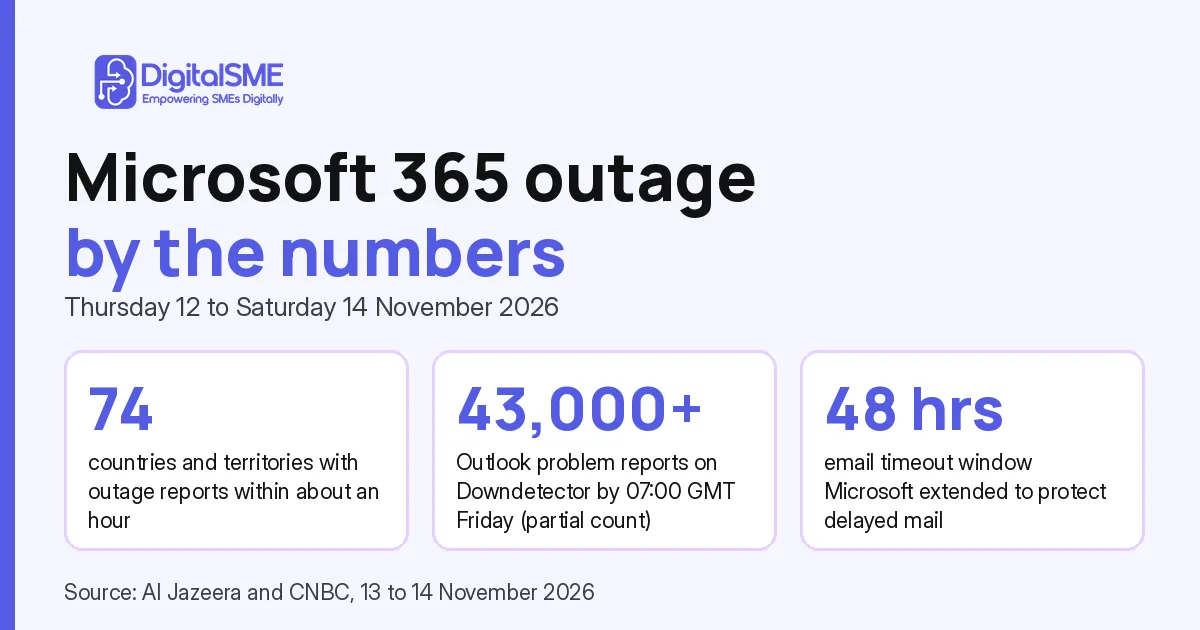
Problems began on Thursday, 12 November 2026, when users could not open Outlook. Within about an hour, the outage tracker Downdetector had logged reports from 74 countries and territories, according to Al Jazeera. By about 07:00 GMT on Friday, the same tracker showed at least 43,000 Outlook problem reports from 72 countries. Al Jazeera notes the true number is likely far higher, because the tracker only counts people who visit it to report an issue.
Microsoft's explanation changed as the incident went on. Early updates described elevated load after a number of servers became unexpectedly unavailable. Later, the company said the disruption stemmed from an issue during an earlier network capacity upgrade, and it said it had not detected malicious activity, as CNBC reported. Recovery was slow: Al Jazeera reported that servers Microsoft restored were failing again.
Microsoft apologized on Friday and extended the email timeout window to 48 hours, so delayed mail kept attempting delivery. On Saturday, 14 November, it said service had been restored to the remaining affected customers and regions. It promised a full report once its assessment was complete, so treat any root cause as provisional until then.
It was not the first failure this year. Al Jazeera notes that Microsoft 365 went down across North America for almost 10 hours in January, and that thousands of Outlook users worldwide were locked out of their mailboxes in late August. Other providers have had their own bad days, including an Amazon Web Services outage in October 2025 and the CrowdStrike update fault in July 2024.
How did the outage reach Indian businesses?
On Friday, 13 November, IndiGo said its email support was affected by the global Microsoft disruption and that it might not be able to receive customer emails, adding that all other support channels remained available. Akasa Air reported similar email delays and pointed customers to its 24/7 care center. Air India said its flight operations were unaffected and that it had temporarily rerouted its emails so every customer message continued to reach it. Moneycontrol carried all three statements.
Each airline either told customers where to go when email failed or moved its mail somewhere that still worked. A smaller business does not need a call center, but it does need one tested way to be reached when the main inbox is down, such as a phone number, a WhatsApp Business line or a web form that stores requests outside your email provider.
Why did AI assistants stop reading Microsoft files?
AI assistants reach your documents and inbox through connectors, and a connector is only as available as the system behind it. Clarin reported that Anthropic listed elevated errors with its Microsoft 365 connector and attributed them to a Microsoft 365 service incident, and that OpenAI reported the same problem with its Microsoft connectors in ChatGPT. ChatGPT stayed online for ordinary prompts but could not scan Microsoft-hosted files or inboxes. Separately, Anthropic's status page listed a login incident on claude.ai on the morning of 13 November, which Clarin described as appearing to be a separate issue.
An AI agent sits on top of your systems, so an agent that reads your inbox and drafts replies stops when the inbox stops. That matters more as small firms adopt AI. A PYMNTS Intelligence survey of 533 small and mid-sized businesses in the United States, reported by PYMNTS, found that 74% use AI at least occasionally. The survey covers US firms, but it shows how many workflows now depend on a connector that can fail.
Why does an outage like this matter for an SME?
When one provider holds your mail, files, chat, calendar and the AI that reads them, one incident stops the whole office at once. James Owen of the consultancy Control Risks told CNBC the episode shows a resilience and dependency problem decades in the making, because companies rely on a small group of technology providers. Walter Pasquarelli, an affiliate researcher at the University of Cambridge, told Al Jazeera it was first of all a communication risk.
Smaller teams have fewer people to run manual workarounds, so the plan has to be short and rehearsed. Neither expert suggested abandoning Microsoft. Pasquarelli said organizations are more likely to focus on digital resilience than to build their own alternatives. For an SME that means keeping the tools and adding a fallback.
What goes into a continuity plan for SaaS outages?
A continuity plan for SaaS outages is a short document that says how the business keeps serving customers when a cloud tool is unavailable. NIST's contingency planning guide, SP 800-34 Rev. 1, was written for US federal information systems, but its recovery options fit any organization. They include running some business processes by alternate, manual means, which NIST says is typically acceptable only for short disruptions. Owen suggested similar measures: manual backups, procedures that work without the internet, more than one supplier, and rehearsals. Six steps cover most of it.
1) Map what each tool does and who depends on it
List every cloud tool the business uses, what it holds, and which people and automations depend on it. Include the quiet dependencies, such as the shared inbox that receives orders, the calendar that drives bookings and any AI assistant that reads them. Rank each by what stops, and how fast, if it disappears.
2) Decide your minimum viable service
Pasquarelli suggested asking what the minimum viable service is during a global outage. Answer it per team. For sales it might be taking orders by phone and writing them on a sheet kept outside your email provider. For support it might be a pinned message with an alternate number. Write the first four hours down in plain language.
3) Give customers a second way to reach you
Choose one backup channel, publish it before you need it, and test it. Draft the wording for an auto-reply or a website banner now, so nobody has to invent it during an incident.
4) Keep a current offline copy of critical data
Export the records you cannot run without, such as customer contacts, open orders, price lists and pending invoices. Schedule the export and store it with a different provider than the one you are protecting against.
5) Pre-write the first-hour message and name an owner
Agree who declares an incident, who talks to customers, and who checks the provider's status page. Microsoft 365 administrators can follow incident updates in the admin center, and that only helps if someone is responsible for looking. Keep a draft message for customers and staff ready.
6) Rehearse it
Once a quarter, pick a tool, announce that it is down, and have the team work through the plan for 30 minutes. Fix whatever breaks, such as a missing phone number or a backup nobody can open.
How should automations and AI agents behave when a tool goes down?
In automation, an outage can turn into silent data loss, so design workflows to fail safely. Four habits help.
- Retry instead of dropping. Queue the task and try again with a growing delay. Microsoft itself kept delayed mail retrying for 48 hours, and your workflows should expect late arrivals too.
- Do not trust arrival time. Microsoft warned that timestamps on delayed emails may show delivery time rather than the original send time, as News18 reported. Record the event time inside the message, not only when it landed.
- Alert on failure through another channel. Send the alert by SMS or WhatsApp to a named owner, not to the inbox that may be down.
- Keep a one-page manual runbook. For each critical automation, write what it does and how a person does the same job by hand for a day.
For AI agents, add one rule: do not let a critical process depend on a single connector without a human fallback. Our guide to automating your business for IPO readiness covers audit-ready records, which also help when a system is down. For help designing agents and workflows that fail safely, see our Business Automation service.
Key takeaways
- The Microsoft 365 outage ran from Thursday, 12 November to Saturday, 14 November 2026, with outage reports from 74 countries and territories.
- AI assistants lost access to Microsoft files because their connectors depend on the system behind them.
- A workable plan covers a dependency map, a minimum service, a second customer channel, offline data copies, a named owner with a ready message, and regular rehearsal.
- Build automations that retry, alert through another channel and have a manual runbook.
Frequently asked questions
What caused the Microsoft 365 outage?
Microsoft said the disruption stemmed from an issue during an earlier network capacity upgrade, and it reported no sign of malicious activity. Early updates had pointed to elevated load after servers became unexpectedly unavailable. Microsoft has said it will publish a full report once its assessment is complete.
How long did the Microsoft 365 outage last?
Problems began on Thursday, 12 November 2026 and spread across Outlook, Teams, Copilot and SharePoint. Microsoft apologized on Friday and said on Saturday, 14 November, that it had restored service to the remaining affected customers and regions. The incident therefore spanned about two days, though many users regained access on Friday.
What is a business continuity plan for an SME?
A business continuity plan is a short written document that explains how a company keeps serving customers when a key system fails. For an SME it lists the tools the business depends on, the minimum service it must maintain, the backup channels and data copies available, who decides what, and how often the plan is tested.
Did AI tools such as ChatGPT and Claude keep working?
Partly. ChatGPT stayed online for ordinary prompts but could not reach Microsoft-hosted files, and Anthropic reported connector errors caused by the Microsoft incident. Anthropic's status page also listed a login problem on claude.ai on 13 November that appeared to be separate. OpenAI's Microsoft connectors also returned errors during the incident.
Where should an SME start?
Start with step one this week: list your tools and what breaks without each. That single page shows where the next outage would hurt most. DigitalSME helps businesses set up clear workflows and AI agents for day-to-day operations, and we can talk through which of yours depend on a single tool. Reach us through the contact page or read more on our Business Automation service page. Common questions are answered in the DigitalSME FAQ.
Last updated: November 15, 2026. Facts reflect public reporting available on that date; Microsoft's full incident report had not yet been published.
Related reading
Share
Trending Topics
-
 November 15, 2026
-
 November 11, 2025
How to Automate Your Business to Make It IPO Ready with a Virtual CFO
Avinav Gupta
A systems-driven operator and growth enabler who blends technology, process design, and execution discipline to build scalable, future-ready businesses.