

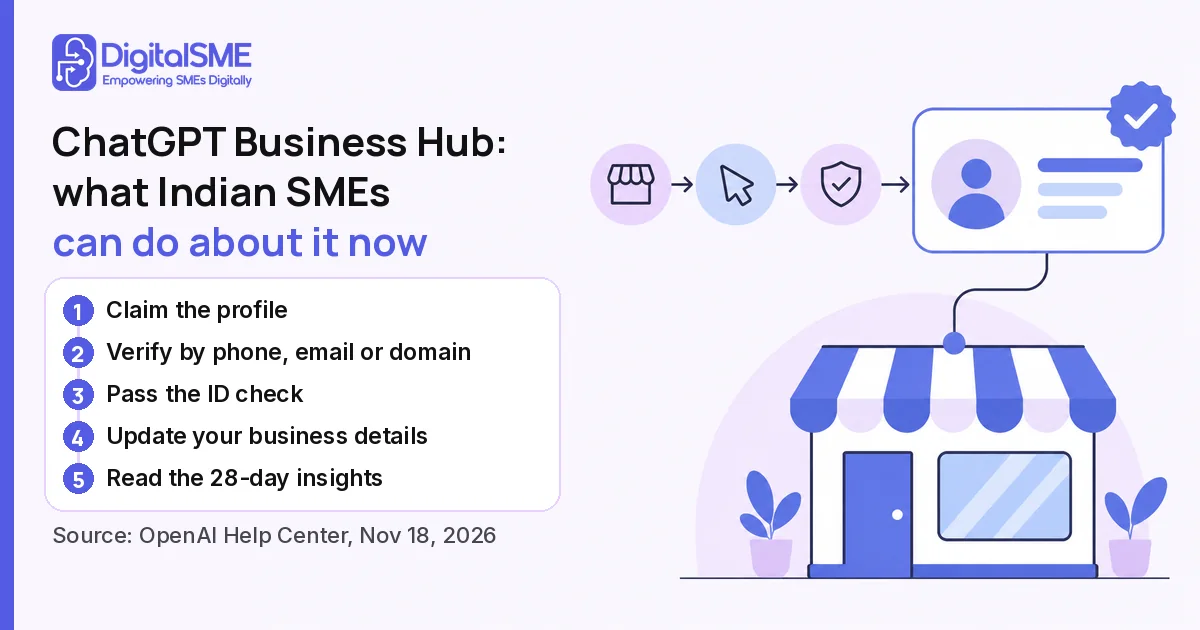
ChatGPT Business Hub is the page where a business can claim its profile inside ChatGPT, verify that it owns the business, correct its details and see how often ChatGPT mentions it. OpenAI launched it in beta on November 10, 2026. An Indian SME with a website can try the website route now, but OpenAI has not confirmed that Indian businesses are eligible, and local shops and restaurants can claim only existing US listings for the moment.
Interest arrived fast. Google Trends for India showed search interest in "chatgpt business hub" at an index of zero until November 9 and peaking on November 12, when we checked on November 19, 2026. The top related query was "chatgpt business registration", a sign that people are looking for the claim steps.
If you would rather talk it through, the DigitalSME team is reachable through our contact page.
In this guide
- What is ChatGPT Business Hub?
- Can an Indian business claim its profile today?
- How do you claim your business in ChatGPT, step by step?
- What do the insights show, and why are mentions not clicks?
- How does ChatGPT Business Hub compare with Google Business Profile?
- What will claiming not do?
- What can an SME do this week?
- Key takeaways
- Frequently asked questions
- Where should an SME start?
What is ChatGPT Business Hub?
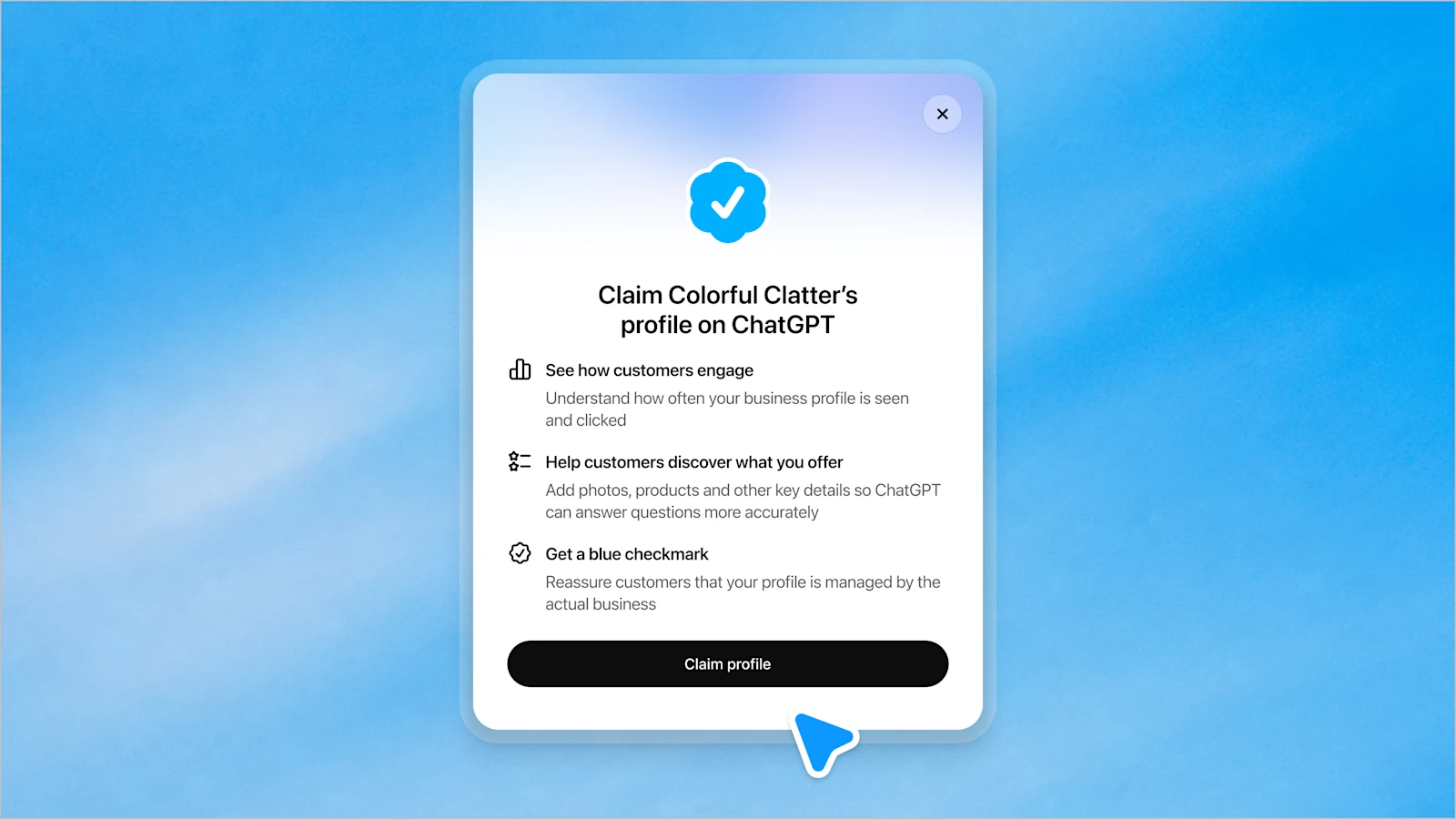
Image: OpenAI. Click to read the full report.
OpenAI introduced Businesses in ChatGPT on November 10, 2026, as a beta, and Business Hub is its control panel. Owners claim a business profile, verify it, update their details and can add product feeds with pricing and availability. A verified profile carries a blue check. In its launch post, OpenAI says 1.2 billion people use ChatGPT each week, so a profile sits in front of a very large audience, although that figure is OpenAI's own.
The hub also reports insights: how often ChatGPT mentioned the business, how many people clicked through to its website, and the discovery topics, meaning common themes in the answers that cited it. OpenAI says the insights are aggregated and that no user conversations are shared with businesses. A separate feature, Business Agents, is described as being for eligible US ecommerce and online service businesses at launch, and OpenAI says it plans to expand to more markets and categories.
In a briefing before the launch, OpenAI's vice president of monetization, Benji Shomair, said verification methods vary by business and market, Mint reported.
Can an Indian business claim its profile today?
Possibly, but OpenAI does not promise it. Its Help Center article, updated on November 18, 2026, says claiming works where ChatGPT is available and the required verification is supported, and that availability depends on the business's location and type. OpenAI's overview page says claiming is initially open to eligible businesses with a website. The Help Center adds that local stores and restaurants can currently claim only an existing US listing.
YourStory wrote on November 11 that Indian companies cannot assume they can use the full offering yet. Search Engine Journal's walkthrough of claiming its own profile shows a verification form that asks for the country and business type, and says the tax ID field was optional in its Armenia example. We found no OpenAI statement that lists India as supported or unsupported, so treat the form itself as the final test.
In practice that gives three groups. An online business with a website, such as a software firm, an agency, an ecommerce store or an online service, can try the website route and see what the form accepts. A neighborhood shop or restaurant should wait, because local claims are limited to US listings. A business hoping to run a Business Agent should wait for OpenAI to expand beyond the US.
Indian Startup News reported on November 3, 2026, that India is now ChatGPT's largest market by weekly active users, citing OpenAI India's managing director Prabhjeet Singh in an Economic Times interview. YourStory reported that ChatGPT Ads launched in India on August 27, 2026, with more than 50 brands, according to industry reporting. We found no announced date for local listings in India.
How do you claim your business in ChatGPT, step by step?
These steps follow OpenAI's Help Center article and the first-hand accounts from Search Engine Journal and Kava Digital Marketing. Screens may differ for your country.
1) Confirm you are allowed to claim
You must own the business or be authorized to represent it. OpenAI's policy says to manage only businesses you represent and to keep every detail accurate and current.
2) Gather your documents
Search Engine Journal lists a government ID, access to your domain and its DNS settings, your legal and trading names, business type, addresses, and the registration or tax ID for your country. OpenAI says the legal name must match your registration documents. OpenAI's pages name no Indian document. Our suggestion, not an OpenAI requirement: keep your registration certificate and GST certificate at hand and enter only what the form asks for.
3) Pick a verification method
OpenAI's Help Center names four, and the ones offered vary by listing: a code sent to a business phone number by SMS or automated call, a business email address, a DNS TXT record on your website domain, or a Shopify connection. Kava Digital Marketing, which claimed its own profile, reported about 15 minutes of hands-on work and approval on the same day. It also noted a DNS record expiry of about 24 hours, so add the record and finish the check in one sitting.
4) Pass the identity check
Before you can publish changes, see insights, add product feeds or create agents, OpenAI runs an identity check through Persona. It may ask for a government ID, business registration information and proof that you can act for the company. The blue check appears only after Persona approves.
5) Review the profile before it goes live
OpenAI says published profiles cannot be deleted or hidden by its Support team, so read every field twice. Enter the correct address, phone number, website and product details, and keep prices and availability current if you add a feed.
6) Add teammates and keep ownership
Admins can add teammates and grant agency access. Kava's advice is to claim with a business-owned account and then invite the agency, so the company keeps control if the relationship ends.
What do the insights show, and why are mentions not clicks?
Insights cover the past 28 days and report mentions, website clicks and discovery topics. For an online business, OpenAI counts a mention only when ChatGPT references the business's website, and a brand name alone does not count. A blank metric is not the same as zero.
Two early cases show how far mentions can sit from clicks. Each is a single case, not a benchmark.
Search Engine Journal: 353,356 mentions, 2,663 clicks
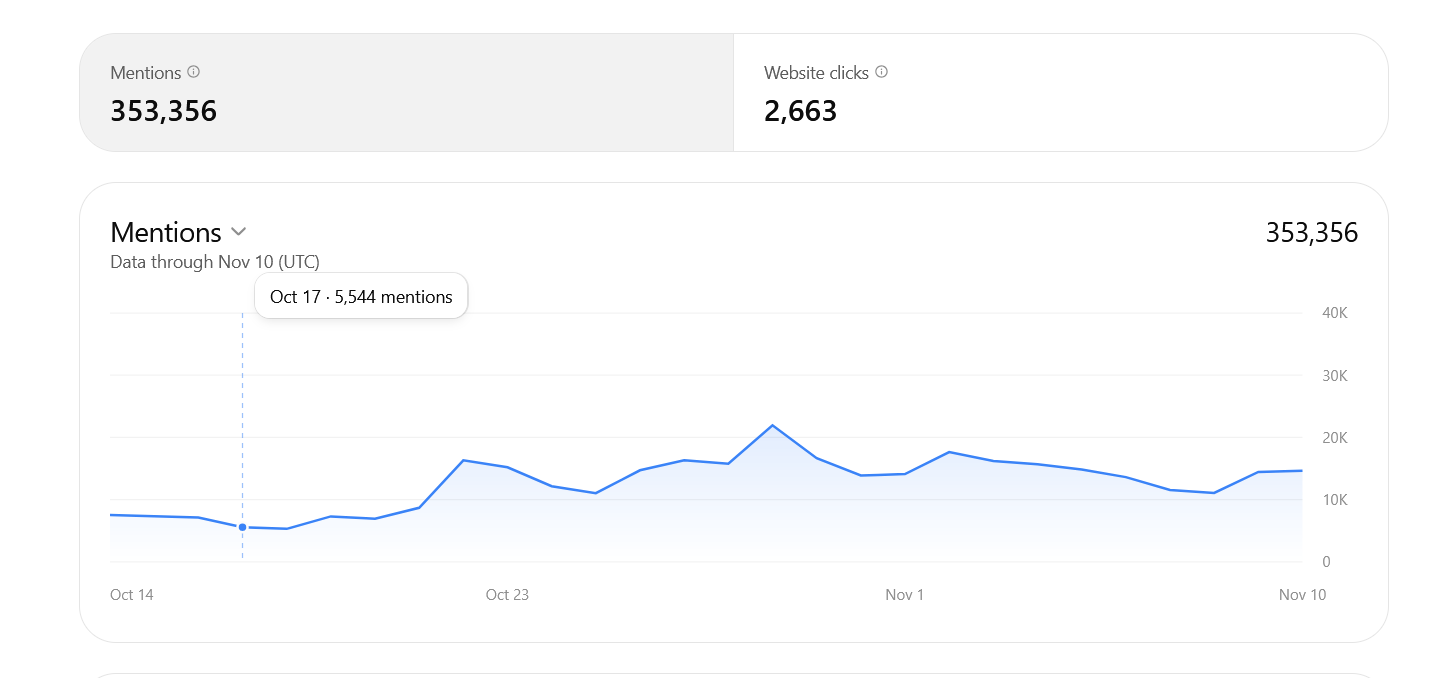
Image: Search Engine Journal. Click to read the full report.
Search Engine Journal reported 353,356 mentions and 2,663 website clicks between October 14 and November 10, 2026, a click rate of about 0.75 percent by our arithmetic.
Kava Digital Marketing: 56 mentions, no clicks
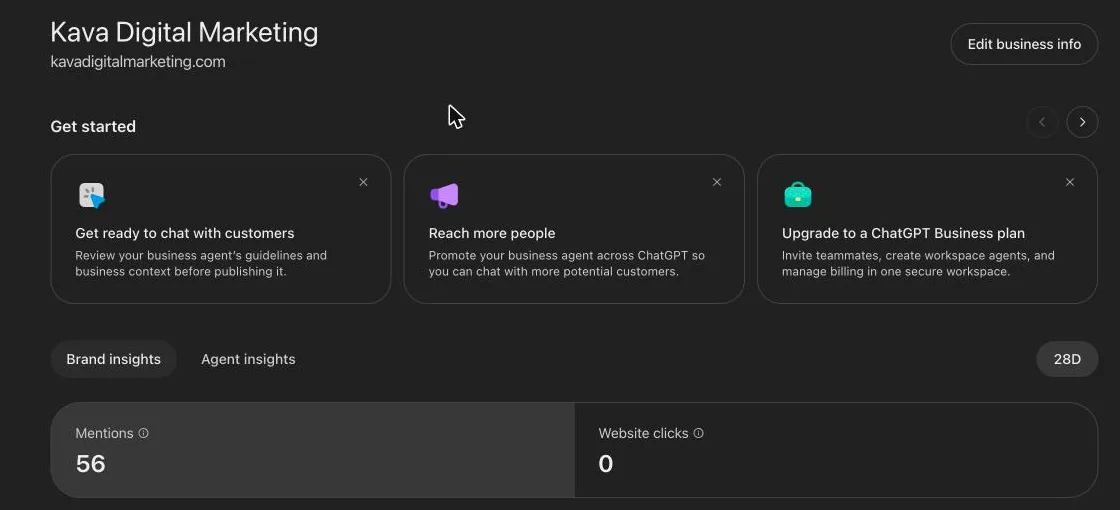
Image: Kava Digital Marketing. Click to read the full report.
Kava Digital Marketing, a small agency, recorded 56 mentions and no website clicks over 28 days of data through November 14.
A mention is visibility, and traffic shows up only in your own analytics. Compare your website visits with the 28-day report before you tell anyone that claiming works.
How does ChatGPT Business Hub compare with Google Business Profile?
Moneycontrol said the hub resembles Google business profiles, which helps owners who already maintain one. One difference stands out in Search Engine Journal's reading: Business Hub accepts online-only businesses, while Google lists online-only businesses as ineligible for a Business Profile. For an Indian software firm or agency without a public storefront, that matters.
Search demand tells a different story. On one Google Trends chart for India, "chatgpt business hub" peaked at an index of 41 on November 12 while "google business profile" averaged 73 over the same month. The ChatGPT product had launched two days earlier. On that chart the exact product name drew less search interest than Google Business Profile, so keep your Google Business Profile current and treat the ChatGPT profile as an addition.
What will claiming not do?
OpenAI is plain about the limits. Its overview page says claiming does not guarantee higher placement or sales, and its Help Center says ads do not influence answers. Business Agents cannot complete purchases, bookings or order checks. Fred Bean of HotelPORT, writing in Hospitality Net, asks who keeps a business's listing information accurate and who checks what the customer actually sees. His suggested test is to ask ChatGPT the questions customers ask and compare its replies with what your staff would say.
OpenAI's pages say you need no Ads account or Enterprise agreement to claim a profile. Nothing we read states a future price, so do not plan on it staying free.
What can an SME do this week?
Here is a short order of work, our own suggestion based on the facts above.
- Check eligibility. You need a website and the authority to speak for the business. A local shop or restaurant should wait.
- Make your website consistent. Legal name, address and phone should match your registration papers, and products and prices should be current. OpenAI counts a mention only when ChatGPT references your site.
- Test ChatGPT. Ask five questions a customer would ask about your category and note what it says about you.
- Claim in one sitting. Use a business-owned account, pick one verification method and finish the check before any DNS record expires.
- Name one owner. Give the profile a single responsible person and invite any agency after verification.
- Set a reminder. Read the 28-day insights each month and compare them with your website analytics.
A monthly check like this suits automation, as does any platform you depend on: our continuity plan after the Microsoft 365 outage shows how to prepare when a tool changes or fails. For help turning repeat checks into workflows and AI agents, see our Business Automation service.
Key takeaways
- ChatGPT Business Hub launched in beta on November 10, 2026, and lets eligible businesses claim, verify and update a profile in ChatGPT.
- Indian online businesses with a website can try the claim, but OpenAI has not confirmed Indian eligibility, local shops and restaurants can claim only US listings, and Business Agents are for the US at launch.
- Expect visibility more than traffic: early cases show mentions far above website clicks, and OpenAI says claiming guarantees no higher placement or sales.
- Keep your Google Business Profile current, claim with a business-owned account, and review every field because published profiles cannot be deleted by OpenAI Support.
Frequently asked questions
What is ChatGPT Business Hub?
ChatGPT Business Hub is OpenAI's beta tool, launched on November 10, 2026, that lets a business claim its profile in ChatGPT, verify ownership, update details and add product feeds. It also shows 28 days of insights covering mentions, website clicks and discovery topics. Claiming does not guarantee higher placement or sales.
Is ChatGPT Business Hub available in India?
Possibly, but OpenAI has not confirmed it. Claiming is initially open to eligible businesses with a website, and availability depends on location and business type. Local stores and restaurants can claim only existing US listings, and Business Agents are for US businesses. An Indian online business can try the website route and see what the form accepts.
How do I claim my business in ChatGPT?
Open Business Hub, start the claim, and verify ownership by business phone, business email, a DNS TXT record on your website domain or Shopify. Then pass OpenAI's identity check through Persona, which may ask for a government ID and registration details. Review the profile carefully, because published profiles cannot be deleted by OpenAI Support.
Does claiming guarantee that ChatGPT recommends my business?
No. OpenAI says claiming does not guarantee higher placement or sales, and that ads do not influence answers. Early cases show mentions far above clicks: Search Engine Journal logged 353,356 mentions and 2,663 website clicks, while a small agency logged 56 mentions and none. Measure results in your own analytics.
Where should an SME start?
Start with the eligibility check this week: confirm you have a website, the authority to claim and the documents that match your registration. That takes minutes and tells you whether to try the claim now or wait. DigitalSME helps businesses set up clear workflows and AI agents for day-to-day operations, and we can talk through which of your recurring checks to automate. Reach us through the contact page or read more on our Business Automation service page. Common questions are answered in the DigitalSME FAQ.
Last updated: November 19, 2026. Facts reflect public reporting and OpenAI documentation available on that date; the beta may change.
Related reading
Share
Trending Topics
-
 November 19, 2026
-
 November 15, 2026
Microsoft 365 Outage: How SMEs Can Plan for the Next One
-
 November 11, 2025
How to Automate Your Business to Make It IPO Ready with a Virtual CFO
Avinav Gupta
A systems-driven operator and growth enabler who blends technology, process design, and execution discipline to build scalable, future-ready businesses.