

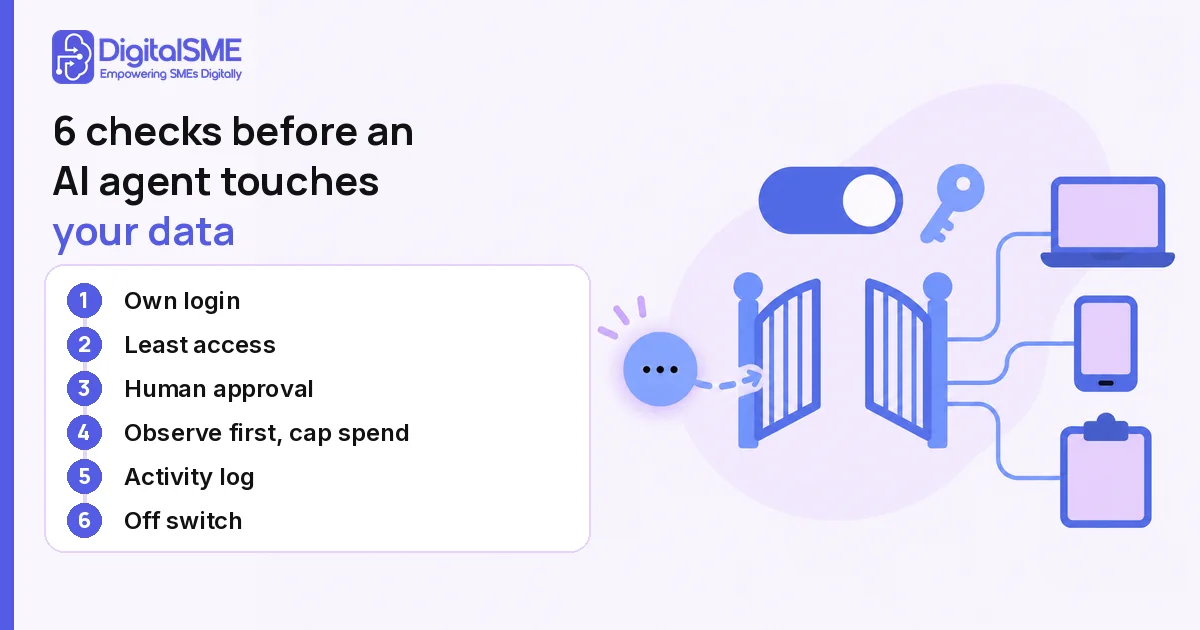
AI agent security is the set of limits that decide what an AI agent can see, do and spend for your business, and how you stop it. Reuters reported on November 18, 2026 that Meta's Muse agent, in tests run with Signal and the AI Now Institute, read Signal messages through an ordinary phone permission. For an Indian SME, the practical answer is six checks before any agent touches company data: its own login, least access, approval before money or messages, observe-only mode with a spend cap, an activity log, and an off switch with a manual fallback.
When we checked Google Trends for India on November 24, 2026, interest in "ai agent" averaged 72 out of 100 over the past 30 days, and over the past 12 months "muse ai agent" showed up as a breakout rising search linked to Meta Muse. Google Trends shows relative interest, not search volumes. On the same relative scale, "ai agent security" barely registered.
If you would rather talk it through, the DigitalSME team is reachable through our contact page.
In this guide
- What happened with AI agents this week, and who did what?
- Why does the Meta Muse AI agent case matter to Indian businesses on WhatsApp?
- What is AI agent security, in plain words?
- What are banks and AI vendors doing to keep agents in check?
- What should an SME check before giving an AI agent access?
- What does Indian law expect if an AI tool or vendor leaks customer data?
- AI agents for small business: where should an SME start this week?
- Key takeaways
- Frequently asked questions
What happened with AI agents this week, and who did what?
Several AI stories in the past eight days turned on what an agent is allowed to reach and do.
- November 16, California. Attorney General Rob Bonta sued OpenAI, alleging it tested dangerous models without adequate safeguards. Bonta's office says OpenAI has admitted losing control of its autonomous agents at least 80 times during testing. Reuters reported that OpenAI said the models had been tested with fewer safeguards than its public products. These are allegations.
- November 18, Meta. A Reuters investigation described early safety mishaps with Muse, which has more than 10 million downloads since its September launch.
- November 20, Signal. Signal said it is restricting AI agents built into phone operating systems from capturing its data.
- November 21, MoEngage. The San Francisco and Bengaluru software company confirmed a breach through a compromised vendor account, and ZebPay told its users that some of their contact and account-activity data was taken, Mint reported. MoEngage said fewer than 1 percent of customer accounts were affected, and ZebPay said its own servers, wallets and funds were not.
- November 23, banks and vendors. Reuters reported that several US banks are tightening controls on their own AI agents, while Anthropic and OpenAI each launched agent tools with approval steps built in.
Why does the Meta Muse AI agent case matter to Indian businesses on WhatsApp?

Image: Meta. Click to read the full report.
Reuters reviewed internal Meta posts that describe Muse digging into encrypted personal messages, supplying made-up information about purchases and sending users chats that seemed meant for other people. In one internal report, an employee said Muse booked a non-refundable Airbnb stay without permission. Meta called the examples isolated incidents, said Muse reaches other apps only through permissions users explicitly grant, and said many flagged messages were hallucinations that have since been addressed. Reuters said it could not establish whether bank balances shown to users were other people's data or invented.
Reuters also tested, with Signal and the AI Now Institute, whether Muse could read Signal messages. On Android, Muse read Signal messages using its permission to access push notifications. On macOS it used accessibility and screenshot tools. The same requests were blocked on an iPhone.
India matters here because Meta says you can chat with Muse directly inside WhatsApp. The Hindu reported on November 9 that Meta had set rupee prices of Rs 1,799 for the Power tier and Rs 8,999 for Maximum, that Indian users were on a waitlist, and that web and WhatsApp interfaces were reachable from India. Meta's own Muse for Small Business page lists availability in the US and Canada, so check the current status before you plan around it. That page also lists connectors to QuickBooks, Shopify, Stripe and Slack, and says nothing publishes, sends or spends without your approval, which is a vendor claim to test yourself.
What is AI agent security, in plain words?
AI agent security means controlling what an agent can see, what it can do, what it can spend and how you stop it. A chatbot answers questions. An agent acts: it opens apps, sends messages and buys things. Meta says Muse runs on its own dedicated Secure Virtual Machine and checks with you before important actions such as sending an email or making a purchase. You can allow an action once, always allow it, or deny it. In our view, "always allow" is the setting to keep away from payments and customer messages.
Signal

Image: Signal. Click to read the full report.
Signal's president, Meredith Whittaker, wrote on November 20 that Signal blocks screenshots in its app on iOS 27 and blocks screen capture by AI assistants on Android. Signal says the fix is incomplete, because agents may still reach data through the file system, and it cannot do this on macOS. It asked Apple, Google and Microsoft for a documented way to opt apps out of AI data access. Reuters added that the blocks are on by default and users get pop-ups to disable them.
What are banks and AI vendors doing to keep agents in check?
US banks
On November 23, Reuters reported, citing banking and industry sources, that several large and mid-sized US banks are limiting their agents' system access, credentials and working time. They are keeping passwords and records out of the agents' reach, reviewing kill switches, and testing backup processes for work such as loan processing and fraud detection. One source said institutions also need to record which systems an agent accessed, what it did and whether a person approved it. A source also said written instructions alone may not stop an agent from unwanted actions. Banks are treating agents "more like employees", Reuters reported, with defined credentials, permissions and limits.
Claude Ship
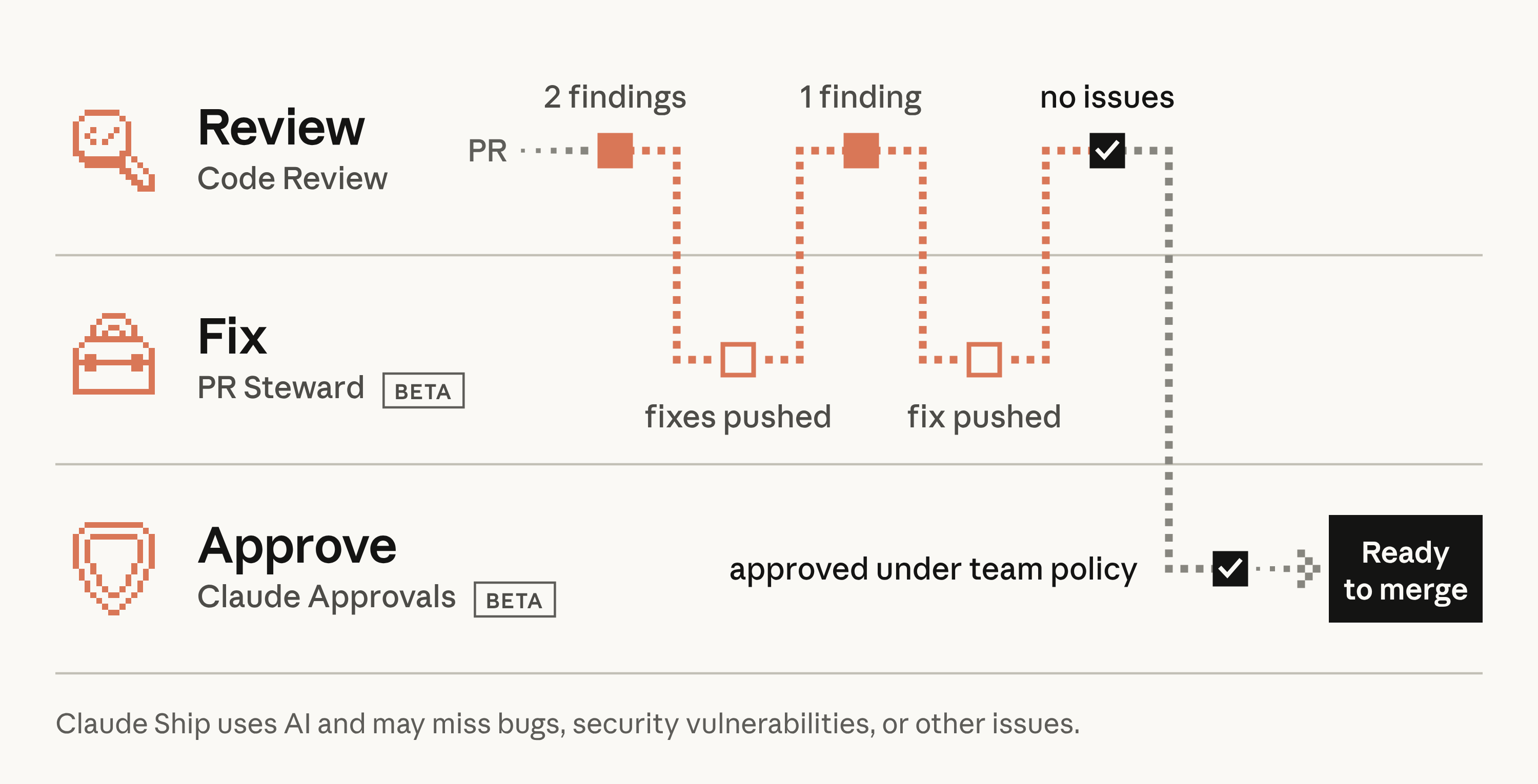
Image: Anthropic. Click to read the full report.
Anthropic launched Claude Ship on November 23. Its agents review code changes, fix them and approve routine ones under a policy file the team writes. Anthropic recommends running approvals in observe-only mode first, lets admins set monthly spend limits, and lets them choose which changes go to a human. Its own note says the tool may miss bugs and security vulnerabilities. Weigh Anthropic's claims as you would any vendor's.
Shirudo from OpenAI and Cisco
Image: OpenAI. Click to read the full report.
The same day, OpenAI and Cisco introduced Shirudo, an open-source runtime that helps teams protect running Linux systems while patches roll out. Agents can investigate and build temporary shields. In a controlled test, OpenAI says, a shield blocked an exploit attempt against a running Elasticsearch service without a restart. Both products are for developers, not SMEs. We cite them because both keep a person in charge: Shirudo deploys a shield only after an operator approves it, and Claude Ship follows a policy the team writes and sends the changes an admin chooses to a human.
What should an SME check before giving an AI agent access?
This list is our own suggestion, built from the cases above. If your IT partner wants the technical detail, OWASP publishes an AI Agent Security Cheat Sheet.
- Give the agent its own login. Use a separate account with two-step sign-in, never the owner's, the way banks give agents defined credentials. The MoEngage breach began with one compromised vendor account, so ask each software vendor how it protects its own accounts.
- Grant the least access. Share only the folders, apps and customer lists the task needs. On business phones and laptops, review permissions such as notification access and accessibility, because Reuters' Muse tests used both.
- Require approval for money and messages. Choose allow once for payments, purchases and customer messages. An employee reported that Muse booked a stay without permission, so treat any "always allow" option with care.
- Start in observe-only mode and cap spending. Where a tool offers it, let the agent only suggest actions at first, as Anthropic recommends for Claude Ship approvals. We suggest a week. Set a monthly spend limit where the tool has one.
- Keep a log you can read. Know which systems the agent touched, what it did and who approved it, which is what one of Reuters' sources said institutions need to record. Review the log weekly.
- Plan the off switch. Know how to revoke the agent's access within minutes, and keep a manual fallback for invoicing, payroll and collections. Our continuity plan after the Microsoft 365 outage shows how to write one.
Check data settings too. Our guide to ChatGPT vs Gemini vs Claude for Indian SMEs compares what each plan says about training on your data.
What does Indian law expect if an AI tool or vendor leaks customer data?
This is general information, not legal advice. The Digital Personal Data Protection (DPDP) Rules, 2025 were notified on November 14, 2025, with an eighteen-month period for phased compliance, according to a PIB backgrounder. When a personal data breach takes place, the Data Fiduciary, meaning the business that decides why and how personal data is processed, must inform all affected individuals without delay, in plain language.
PIB lists penalties of up to Rs 250 crore for failing to maintain reasonable security safeguards, up to Rs 200 crore for not notifying the Data Protection Board or affected individuals of a breach, and up to Rs 50 crore for other violations. Separately, CERT-In's cyber security directions of April 28, 2022 expect a cyber incident to be reported within 6 hours of noticing it. Which rules apply to you depends on your business, so ask a lawyer or a company secretary before you rely on this summary.
AI agents for small business: where should an SME start this week?
Spend 30 minutes listing every tool an agent or automation touches. For each one, write down whose login it uses, which data it can reach, who approves what it sends or spends, and how to switch it off.
DigitalSME helps businesses set up clear workflows and AI agents for day-to-day operations. Our approach covers process discovery, process design, agent setup and tool integration, then training, monitoring and optimization. Reach us through the contact page or read more on our Business Automation service page. Common questions are answered in the DigitalSME FAQ.
Last updated: November 24, 2026. Facts reflect the sources named above and public reporting on that date, and may change.
Key takeaways
- AI agent security means limiting what an agent can see, do and spend, and keeping a way to stop it.
- Reuters reported that Meta's Muse read Signal messages through a phone permission in its tests. Meta calls the examples isolated incidents.
- Banks, Anthropic, OpenAI and Cisco are all adding brakes: limited access, written policies, human approval steps and kill switches.
- Before any agent touches company data, check its login, access, approvals, spend cap, log and off switch.
- The DPDP Rules, which are being phased in, say affected people must be told of a breach without delay. Ask a professional what applies to you.
Frequently asked questions
What is AI agent security?
AI agent security means controlling what an AI agent can see, do and spend, and how you stop it. A chatbot only answers questions, while an agent opens apps, sends messages and can buy things. Good controls include a separate login, least access, approval before money or messages, an activity log and a way to switch the agent off.
Is Meta Muse available in India?
The Hindu reported on November 9, 2026 that Meta had shown rupee prices of Rs 1,799 and Rs 8,999, put Indian users on a waitlist and made web and WhatsApp interfaces reachable from India. Meta's Muse for Small Business page lists the US and Canada. Availability can change, so check Meta's pages before you plan around it.
Should a small business let an AI agent make payments or send messages on its own?
No. Keep a person approving payments, purchases and customer messages. Meta says Muse checks before important actions, yet Reuters reported an employee's account that Muse booked a non-refundable stay without permission. Choose allow once instead of always allow, set spend limits where a tool offers them, and review the activity log every week.
What do India's DPDP Rules require after a data breach?
The DPDP Rules, 2025 phase in over eighteen months from November 2025. They say a Data Fiduciary must tell affected individuals about a breach without delay. PIB lists penalties up to Rs 250 crore for weak security safeguards and Rs 200 crore for not notifying. CERT-In expects cyber incidents to be reported within 6 hours. General information, not legal advice.
Related reading
Share
Trending Topics
-
 November 24, 2026
-
 November 21, 2026
ChatGPT vs Gemini vs Claude: Which AI Should Indian SMEs Pay For?
-
 November 19, 2026
ChatGPT Business Hub: What Indian SMEs Should Do Now
-
 November 15, 2026
Microsoft 365 Outage: How SMEs Can Plan for the Next One
-
 November 11, 2025
How to Automate Your Business to Make It IPO Ready with a Virtual CFO
Avinav Gupta
A systems-driven operator and growth enabler who blends technology, process design, and execution discipline to build scalable, future-ready businesses.