

Your developer has found a cheaper engine for the customer-support bot. It runs on GPUs in India, costs Rs 14 per million input tokens, and switching takes three changes: the endpoint, the key and the model name. Then someone in the review asks the question that filled Indian tech news this week: isn't that a Chinese model?
That question sits at the center of the Sarvam AI row. When Sarvam AI launched Token Factory on November 16, 2026, it began serving open-weight models from DeepSeek, Moonshot AI and Z.ai next to its own, and an online backlash followed. The fair question is only the first of four you should ask before customer data goes into any AI tool.
This guide is for SME owners and operations heads who use, or are about to adopt, an AI model or agent. It gives you the four questions, the settings to change before the first real prompt, a cost example on our arithmetic, and our checklist.
Key takeaways
- Treat who built the model and who runs it as two checks. Sarvam says prompts stay on its GPUs in India, but a foreign-built model still needs testing on your data.
- Change the defaults before the first real prompt. On Sarvam's platform, data is kept indefinitely until an Owner sets a period, and content may train its models unless you opt out.
- Budget for 2027. Sarvam's introductory rates run through the end of 2026, and the rate after that is not published.
- Under the DPDP Act, you stay responsible for what your AI vendor does with customer data, so put retention, training and erasure terms in the contract.
Want a second pair of eyes on your AI setup before you sign? Book a call with the DigitalSME team.
In this guide
- The Sarvam AI row raises a question every AI buyer has to answer
- Who built a model and who runs it are two separate checks
- Where your prompts are processed decides which risks you carry
- Default settings decide what is kept and what trains the model
- Sarvam AI pricing is low today, so budget for the rate after 2026
- Indian AI hosts are multiplying, so compare them on the same four questions
- How we would choose an AI provider for an SME
- What happens next
- Frequently asked questions
The Sarvam AI row raises a question every AI buyer has to answer
The row looks like a national-policy fight, and partly it is. Underneath it sits a buying question for any business using AI: what are you plugging your customer data into?
Image: Sarvam AI. Click to read the full report.
Sarvam describes Token Factory as an inference stack serving its own and leading open-weight models from GPU clusters in India. NDTV's Bloomberg report says the launch drew an online backlash. Co-founder Vivek Raghavan replied that private money funds the chips and that any model hosted on outside servers carries a risk of data exfiltration.
The government then weighed in. CNBC-TV18 reported on November 25 that MeitY Secretary S Krishnan sees no conflict with the IndiaAI Mission and has seen no misuse of the support the government extended. In a November 22 clarification, covered by The Hindu, Sarvam co-founder Pratyush Kumar said building inference does not conflict with the company's mission of training its own models.
You can act without settling that argument. Four questions turn the row into something you can check.
| The question | Why it matters | What Sarvam publishes |
|---|---|---|
| Who built the model? | Origin shapes behavior, so you must test. | The pricing page names each model's developer. |
| Where are prompts processed? | The data path decides who can see what. | Sarvam says prompts run on its GPUs in India and are not forwarded to the developer's overseas API. |
| What is kept, and what trains the model? | Defaults apply until you change them. | Data is retained indefinitely until an Owner sets a period, training use is on unless you opt out, and zero retention is on request. |
| What will it cost later? | Introductory prices end. | Introductory pricing runs through the end of 2026, and the later rate is not published. |
Ask these four questions of every AI tool you already use, not only the new ones.
Who built a model and who runs it are two separate checks
Where a model runs tells you about the data path, not about who built it or how it behaves. Business Standard's explainer makes the point that running open-weight models on Indian GPUs does not make them Indian, transfer their intellectual property to Sarvam or give India control over their development.
For a buyer, the practical step is to read the label. On Sarvam's pricing page, every model names its developer. On our count of that page on November 26, 12 models are listed: six from Chinese developers (DeepSeek, Z.ai, Moonshot AI and Alibaba), three from Sarvam, two from Google and one from Cloudflare.
That is why "is DeepSeek safe?" is really two questions. The first is a hosting question: where do my prompts go? Sarvam says they stay on its GPUs in India. The second is a testing question: how does the model behave on my tasks? YourStory notes that domestic hosting does not by itself resolve concerns about software supply chains and model behavior. Nothing we read tests how these models behave on your data, so we will not hand you a yes or no.
Sarvam's own FAQ tells customers to validate answer quality, tool use and response times on representative requests when they change models. Do the same. Ask for each model's developer and licence, then run 20 to 30 of your own anonymized requests and have a person score the answers. The 20 to 30 is our suggestion, not a sourced benchmark.
Where your prompts are processed decides which risks you carry
Your data path is longer than the model. Sarvam's Token Factory FAQ says inference runs on Sarvam-operated GPUs in India, that Sarvam hosts the weights and that requests are not forwarded to the original developer's overseas API. It adds that external tools your application connects to have their own processing locations and data policies.
Picture a WhatsApp support agent whose model runs in India but whose CRM or email tool runs elsewhere. A customer's phone number can cross that border without touching the model. That is our illustration. Our guide to AI agent security for Indian SMEs covers what connected tools can reach.
A note on Indian law, which is general information and not legal advice. Under section 8 of the Digital Personal Data Protection Act, 2023, a business that decides how personal data is processed stays responsible for processing done on its behalf by a Data Processor, whatever an agreement says, and may use one only under a valid contract. Section 16 lets the Central Government restrict transfers of personal data to countries it notifies.
Draw the data flow on one page, with the model host and every connected tool on it, before you sign anything.
Default settings decide what is kept and what trains the model
Most users never touch a platform's defaults, so the defaults are the policy. Sarvam's data retention documentation says that until an account Owner sets a retention period, the workspace's data is retained indefinitely and nothing is deleted automatically. Only the Owner can change the policy, and a change is not retroactive.
Training is a separate switch. The Token Factory FAQ says Sarvam may use your content to train, fine-tune or improve its models by default, unless you opt out through account settings or by writing to support. Zero data retention is available on request, but the same page says operational logs are scoped separately in your terms.
Ask about caches too. Sarvam's launch post says prompts can sit in a shared cache for hours or days. We cannot tell whether zero retention covers that cache, so ask in writing.
Retention also touches the law. Section 8 of the DPDP Act says that when consent is withdrawn or the purpose is served, you must erase the personal data and make your Data Processor do the same, unless a law requires you to keep it. This is not only a Sarvam issue: our comparison of ChatGPT, Gemini and Claude for Indian SMEs looks at what mainstream plans say about training on your data.
Set retention and the training opt-out on day one, name who holds the Owner login, and get the settings confirmed in writing.
Sarvam AI pricing is low today, so budget for the rate after 2026
Sarvam AI pricing starts low because the best rates are introductory. Sarvam's API docs say introductory pricing covers Sarvam 105B, its Conversations variant and the standard DeepSeek V4.1 Flash model through the end of 2026. The rate after that is not published, so any budget past December is a guess.
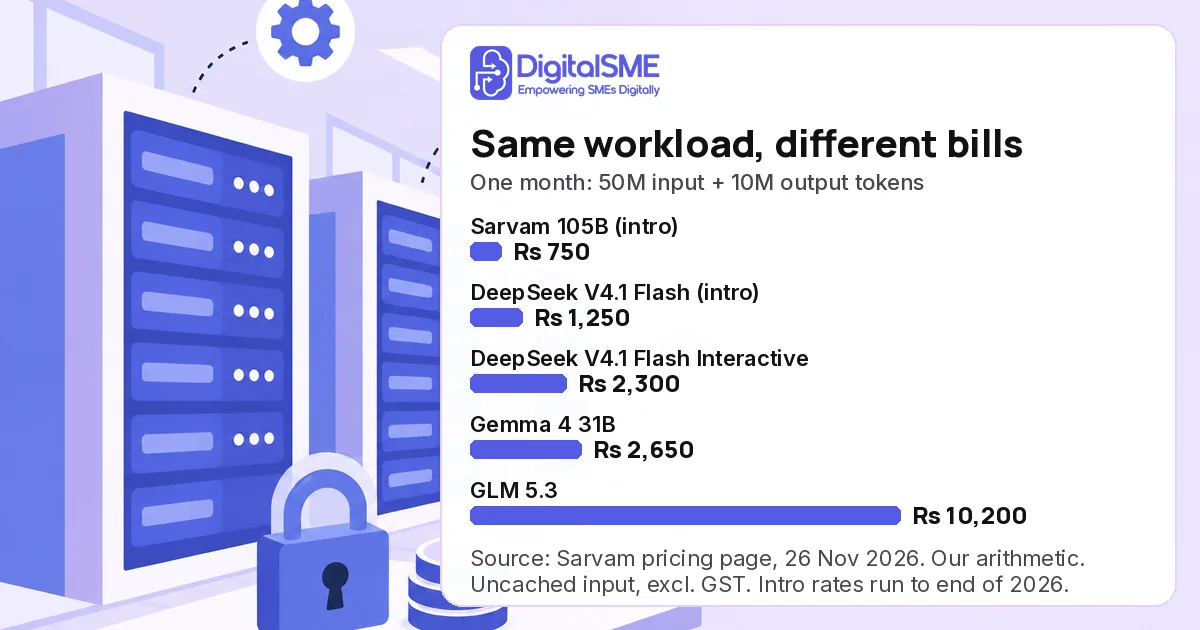
Rates are in rupees per million tokens, excluding GST. The table shows one illustrative month on our arithmetic: 50 million input tokens and 10 million output tokens, none of the input cached.
| Model on Token Factory | Input (Rs per million) | Output (Rs per million) | Illustrative month |
|---|---|---|---|
| Sarvam 105B (introductory) | 10 | 25 | Rs 750 |
| GLM 5.3 Flash | 13.50 | 45 | Rs 1,125 |
| DeepSeek V4.1 Flash, Standard (introductory) | 14 | 55 | Rs 1,250 |
| DeepSeek V4.1 Flash, Interactive | 25 | 105 | Rs 2,300 |
| Gemma 4 31B | 35 | 90 | Rs 2,650 |
| GLM 5.3 | 126 | 390 | Rs 10,200 |
Source: Sarvam Token Factory pricing page, read November 26, 2026. The monthly totals are our arithmetic, not a quote.
Three things move the bill more than the headline rate. The spread: the dearest model here costs more than 13 times the cheapest for the same workload. Reasoning: Sarvam bills reasoning tokens at the output rate, and its own code sample defaults to maximum reasoning. Caching: cached input on the standard DeepSeek model costs Rs 0.25 per million against Rs 14, about 98% less.
Budget at a stress-test rate. The Interactive endpoint of the same DeepSeek model, which is not on introductory pricing, costs 1.8 times the Standard input rate and 1.9 times the output rate, on our arithmetic. That is not the future Standard price, which Sarvam has not stated, but it shows the size of the swing. Cap reasoning effort for routine tasks and review the price before the year ends.
Indian AI hosts are multiplying, so compare them on the same four questions
Sarvam is one of several Indian options. Business Standard reports that E2E Networks launched its Blaze inference platform on November 2, and YourStory adds that L&T, Jarvislabs, Utho Labs and Mirror Security are building similar offerings.
Image: Sarvam AI. Click to read the full report.
If you would rather use a model built in India, Sarvam released a new Sarvam 105B checkpoint on November 22. Its post says it targets high-volume work such as customer support, and that a 65 GB version runs on a single workstation GPU. Those are Sarvam's own claims, so test it like any other model.
Open-weight models can also run on your own servers, a real option for your most sensitive data if you have people to run them. Send the same four questions to two or three hosts and compare the written answers.
How we would choose an AI provider for an SME
This list is our own suggestion, in the order we would follow before any AI goes near customer data.
- Step 1. List the data first. Write down what the AI will touch: customer details, invoices, payroll records. The list decides how strict the rest has to be.
- Step 2. Send the four questions in writing. Ask the four questions of each provider and keep the answers with the contract.
- Step 3. Change the defaults on day one. Set a retention period, switch off training where you can, and ask for zero retention for sensitive data. Name who holds the Owner login, since only the Owner can change the policy.
- Step 4. Test on your own requests. Run 20 to 30 anonymized real requests through each shortlisted model and score the results.
- Step 5. Keep the model swappable. OpenAI-compatible APIs make a switch quick, but check the outputs after each one. Keep a manual fallback, as in our continuity plan after the Microsoft 365 outage.
- Step 6. Check the contract against the DPDP basics. Look for a valid contract, erasure on request and security safeguards, plus a promise to tell you quickly about any breach, because the PIB backgrounder on the DPDP Rules says you must inform affected individuals without delay. Ask a professional what applies to you.
- Step 7. Diarize the price review. Put a date in the calendar before the introductory rates end, and compare at least two hosts.
This is the groundwork we would do before any AI agent goes live. Our Business Automation with AI Agents & Skills service covers process discovery, agent setup, tool integration and monitoring.
What happens next
The government says it will keep backing Sarvam's trillion-parameter model work, Sarvam says new open-weight models will arrive from day one, and more Indian hosts are launching. Each brings the same four questions back.
Two dates matter. Sarvam's introductory rates run through the end of 2026, and the eighteen-month phased-compliance window for the DPDP Rules, which began in November 2025, is still running. Prepare now, not at the deadline.
This week, send the four questions to every AI provider you already pay, change the retention and training settings, and note the date your rates change. If an answer comes back vague, treat that as a reason to wait.
Get Started
Book a Free Consultation
Want AI that keeps customer data where it belongs?
Tell us what you want an AI agent to do, and we will help you choose, set up and monitor it.
Last updated: November 26, 2026. Facts reflect the sources named above and public reporting on that date, and may change.
Frequently asked questions
Why is Sarvam AI hosting Chinese AI models?
Sarvam says Token Factory serves its own and leading open-weight models, including DeepSeek, Moonshot AI and Z.ai models, from GPUs in India. Pratyush Kumar says it runs on privately procured GPUs. On November 25, the MeitY Secretary said he sees no conflict with the IndiaAI Mission and no misuse of government support.
Is DeepSeek safe to use for business data in India?
That is two questions. Where do prompts go? Sarvam says its hosted models run on its GPUs in India and requests are not forwarded to the developer. How does the model behave? Only your own tests can tell. Check that, and the retention and training settings, before using real customer data.
Does Sarvam AI keep or train on my data?
Sarvam's API docs say workspace data is retained indefinitely until an Owner sets a retention period. Its Token Factory FAQ says content may be used to improve its models unless you opt out in account settings. Zero data retention is available on request, with operational logs scoped separately in your terms.
How much does Sarvam AI Token Factory cost?
Prices are in rupees per million tokens, excluding GST. On November 26, Sarvam 105B was Rs 10 for input and Rs 25 for output, and standard DeepSeek V4.1 Flash was Rs 14 and Rs 55, both introductory through the end of 2026. Reasoning tokens bill at the output rate. The later rate is not published.
What does the DPDP Act expect when an SME uses an AI vendor?
You stay responsible for personal data processed on your behalf, may use a Data Processor only under a valid contract, and must take reasonable security safeguards. You must also have the processor erase data when its purpose ends. The DPDP Rules phase in over eighteen months from November 2025. This is general information, not legal advice.
Related reading
Share
Trending Topics
-
-
 November 24, 2026
AI Agent Security: What the Meta Muse Scare Means for Indian SMEs
-
 November 21, 2026
ChatGPT vs Gemini vs Claude: Which AI Should Indian SMEs Pay For?
-
 November 19, 2026
ChatGPT Business Hub: What Indian SMEs Should Do Now
-
 November 15, 2026
Microsoft 365 Outage: How SMEs Can Plan for the Next One
-
 November 11, 2025
How to Automate Your Business to Make It IPO Ready with a Virtual CFO
Avinav Gupta
A systems-driven operator and growth enabler who blends technology, process design, and execution discipline to build scalable, future-ready businesses.